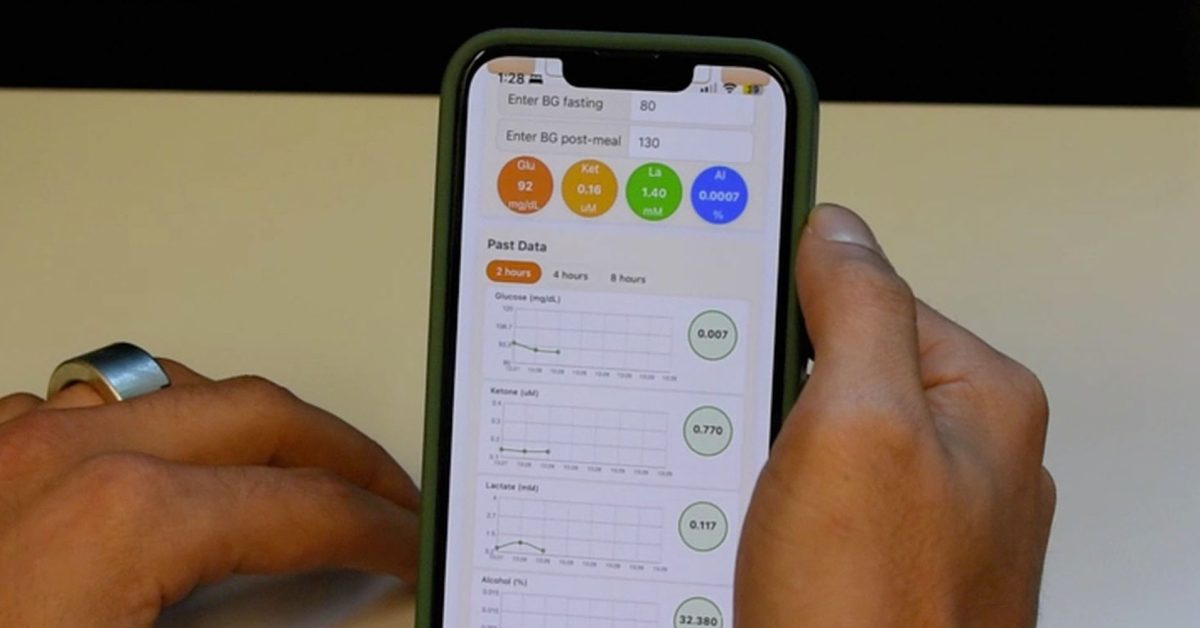

A prototype smart ring developed by engineers at the University of California appears to have cracked one of the holy grails of health wearables: non-invasive blood sugar measurement. The data is sent to a companion app on a paired iPhone.
While existing smart rings rely purely on biophysical data extracted from sensors like those embedded into the Apple Watch, this ring also tracks chemical biomarkers by analysing sweat.
How Current Smart Rings Work
Today’s smart rings work in the same way as the Apple Watch, using the same core sensors. These enable the collection of an impressive range of data, including resting heart rate, heart rate variability, respiratory rate, temperature, cardiovascular age, activity, sleep cycles, and more.
Supplementing existing sensors with molecular ones could dramatically increase the amount of health data that can be gathered. You don’t even have to work up a sweat — CNET reports that the technology is able to pull sweat directly from your skin.
The UC San Diego Prototype
Engineers at the University of California, San Diego, believe they have created the first smart ring that uses finger sweat to track chemical biomarkers. The ring is only a prototype, but it shows the potential for future smart rings to continuously monitor the body on a molecular level instead of relying solely on biophysical data.
In a paper published in Nature Communications on July 23, the engineering team reports that the new smart ring uses sweat to continuously monitor up to four of the following biochemical measurements: glucose, ketones, vitamin C, uric acid, lactate, and alcohol concentrations.
Potential Benefits for Diabetes Management
The ring could be particularly useful for those with Type 1 diabetes.
“The ring’s ability to track both glucose and ketone continuously and simultaneously would greatly benefit optimal insulin dosing for the management of diabetes,” said Joseph Wang, professor in the Aiiso Yufeng Li Family Department of Chemical and Nano Engineering.
Testing showed that the ring achieved accuracy very similar to invasive continuous glucose monitors and traditional blood draws.
The prototype is currently rather chunky and has a battery life of just 12 hours, but commercial versions would likely be able to make significant improvements on both fronts. If the underlying technology can be refined and miniaturised, it could represent a meaningful leap forward for health wearables across the board.